AnyPS5 Relinks Binaries Instead of Emulating Hardware
AnyPS5 bets on binary relinking and library reimplementation rather than hardware emulation. The PS5's x86-64 Zen 2 architecture creates a technical opportunity: relink the executable format, translate system calls, convert shaders to SPIR-V, and run the game code natively. Current limitations include decryption requirements and inconsistent performance, but the architectural choice is technically compelling.
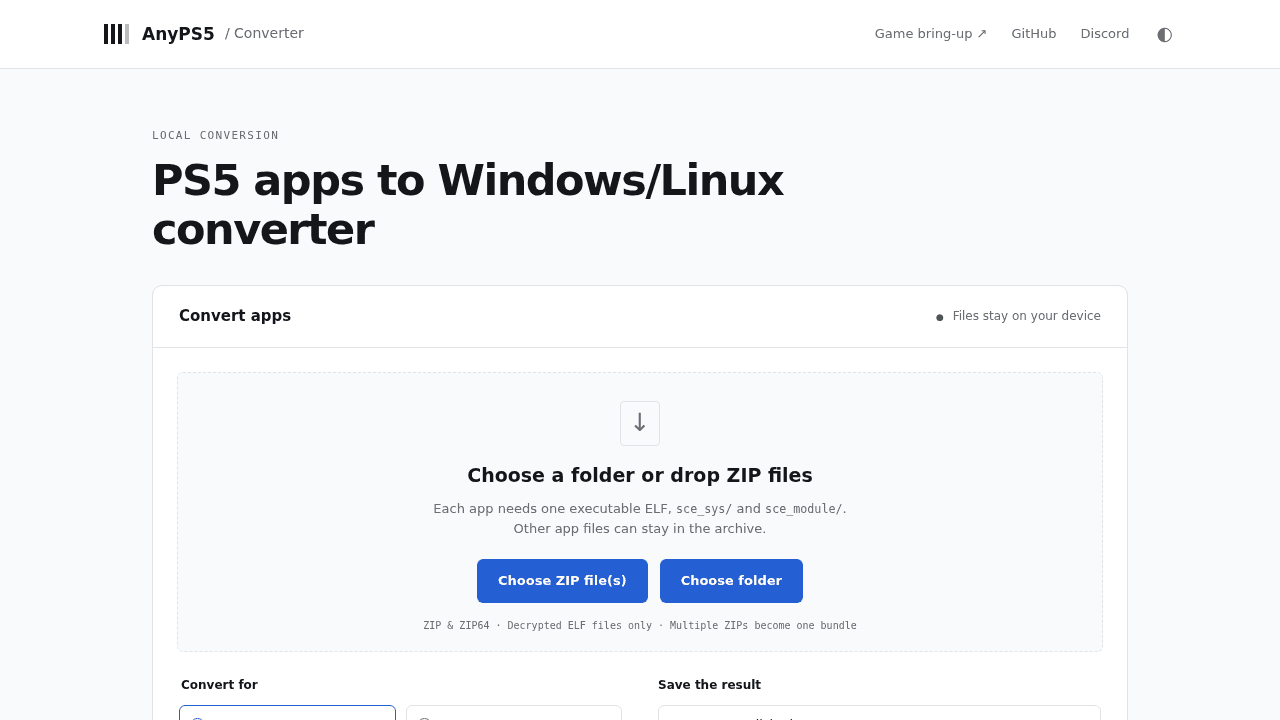
Most console emulators simulate hardware instruction by instruction. AnyPS5 addresses a different problem: what if you skipped emulation entirely and just convinced PS5 games they were already running on a PC?
Sony built the PS5 on AMD's x86-64 Zen 2 architecture—the same instruction set that powers desktop processors. That shared foundation means CPU emulation is unnecessary. The engineering challenge shifts to three layers: converting the binary format, reimplementing Sony's system libraries, and translating GPU shaders.
The architectural bet: relinking instead of emulating
Traditional emulators like PCSX2 or Dolphin interpret every instruction a console's CPU would execute. AnyPS5 takes a different path. Since PS5 games are already compiled for x86-64, the project converts PS5 executable files into Windows PE or Linux ELF binaries and translates PS5 GPU shaders into SPIR-V for Vulkan. The game's code runs natively on your processor. No cycle-by-cycle simulation required.
Coverage compares AnyPS5's architecture conceptually with Wine or Proton: the PS5 program's x86-64 code executes on compatible PC CPUs while system calls, libraries, and graphics interfaces are translated. Where Wine translates Windows API calls to POSIX equivalents, AnyPS5 translates Sony's system calls to their Windows or Linux counterparts.
The conversion pipeline: binaries, libraries, shaders
Three technical layers make this work. First, binary relinking: the PS5's executable format must be converted to PE on Windows or ELF on Linux. This step reorganizes how the operating system loads and executes the program, but the machine code inside remains x86-64.
Second, system library reimplementation. PS5 games expect Sony's system calls—file I/O, memory management, threading, audio output. AnyPS5 reimplements these interfaces so the game can make the same calls it would on a console, but the implementation underneath uses Windows or Linux primitives.
Third, shader translation. The PS5's GPU uses AMD RDNA 2, but games ship with shaders in Sony's format. AnyPS5 converts these to SPIR-V, Vulkan's intermediate representation, so any Vulkan-capable GPU can execute them. Reports of near-complete PS5 GPU shader-instruction coverage and demonstrations of selected games reaching menus or gameplay drove attention to the project.
Current state: decryption requirements and performance variance
The practical limitations are significant. Reddit users identify the input requirement as decrypted eboot.bin files, generally obtained from a jailbroken PS5. Encrypted game files won't work. Online PSN functionality is not supported—games run as if the console is offline, so multiplayer and store access are unavailable.
Performance varies. The repository reports that the open-source titles DOOM and OpenRCT2 reached around 60 FPS in recorded runs. But a separate report measured Palworld at roughly 0.4–0.7 FPS despite warm shader caches and available RAM. The repository documents testing across multiple commercial and open-source titles, including Dreaming Sarah, GTA V, Demon's Souls, Days Gone: Remastered, Red Dead Redemption, and Hades II. Broad compatibility remains an open question.
Two approaches: AnyPS5 vs. KytyPS5
KytyPS5 is a competing project that uses traditional emulation, while AnyPS5 differentiates itself by relinking executables and replacing system libraries. Neither approach is inherently superior. Traditional emulation offers cleaner abstraction and potentially broader compatibility; binary translation offers native execution speed when the underlying architecture aligns. Both projects deserve credit for exploring different solutions to the same problem.
Why x86-64 compatibility changes the equation
Previous console generations made binary translation impractical. The PS3's Cell processor and PS2's MIPS architecture required full CPU emulation. The PS5's x86-64 Zen 2 eliminates that bottleneck. CPU cycles aren't wasted on instruction translation. The challenge shifts to API compatibility and GPU translation—problems that resemble cross-platform abstraction layers rather than hardware simulation.
The repository's activity increased rapidly after its August 2024 creation, with a v0.1.4 release published in late October 2024. The architectural choice is compelling not because it works perfectly today, but because it opens a design space that wasn't practical a console generation ago. The 52,000 stars suggest the community recognizes that novelty.
boykopovar/AnyPS5
Tool for automatic PS5 executables porting to Linux and Windows